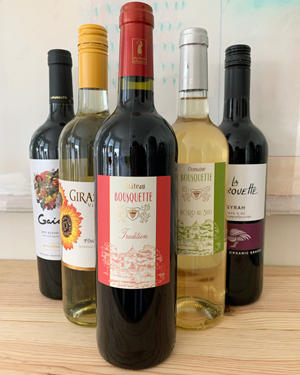
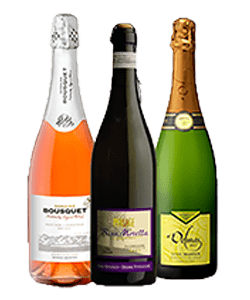
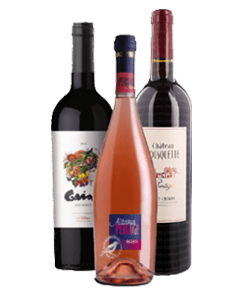
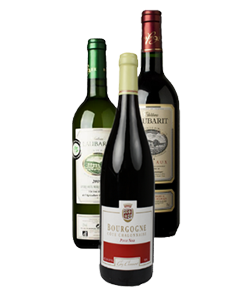
The Organic Wine Company, importer of these unique wines, was founded in 1980 by Veronique Raskin - one of the pioneers of the organic wine movement. Born and raised in the south of France, deeply in love with her ancestor's land, the Domaine de la Bousquette in the Languedoc region, Veronique is committed to offering wines that are pleasurable to drink and respectful of the entire chain of life.
We have selected for your enjoyment wines made with certified organic grapes - Vins biologiques - made in accordance with European organic wine standards. These are elegant, well-made by Europe's organic pioneers and a pleasure to drink.
OWC Newsletter: In praise of the French Culture - The French Heart
Be sure to take a look at our March 2012 Newsletter! This wonderful mailing will bring you to the South of France! The food! The hospitality! The people! ...and, of course, the wine!!
What Drinking Organic Wine
Really Means
You have been eating organic food faithfully all these years but,
you may not have yet added to your organic meals what many cultures do:
a glass of wine. The time may have come.
When you go pick up a bottle of organic wine to accompany your organic meal, part of your problem may be in not knowing exactly what an organic wine is. With all these terms getting thrown around like ecofriendly, "NSA", sustainable, green, natural, truly organic, etc., who could blame you? Having founded The Organic Wine Company in 1980, I am certainly one of the elders of the organic wine movement. I have been actively involved in the developments of organic wine standards and even I am frustrated and confused, so I can imagine that you are just about ready to throw in the towel and walk away from the whole idea. So, let me offer some pointers for you based on thirty years of observation and experience in this industry.
What is really critical for all of us in choosing an organic wine is to make sure that they’re made with 100% certified organically grown grapes. That’s the key. Inspect the label and be sure that an agency has certified the vineyard’s organic practices. Do not be content with vague terms. (Terms like sustainable, natural, and green can be misleading.) When it comes to your health, the workers, and our planet’s longevity 100% certified organic grapes should be your number one criterion. The rest, in my opinion, is well-meant misinformation, poor science or straight up propaganda for commercial purposes.
If you wish to buy wines that promote the health of our planet and every creature on it (including yourself,) then the clear choice is a wine made from third-party certified 100% organically grown grapes. The rule of thumb is that if it doesn’t say it on the label, don’t buy it. Organic wine, like organic carrot or orange juice, is made from grapes grown without the use of pesticides, herbicides and chemical fertilizers. The two types of wines typically bundled in this category are “Wines Made With 100% Organic Grapes” and “No Sulfite Added Wines.” Wines made with 100% organic grapes are made with just that and an additional preservative (elemental sulfur dioxide,) so the wine has structure enough to last the journey to your table. No Sulfite Added wines (or NSA wines) are produced without this naturally occurring preservative and are made by only a handful of winemakers in the United States.
We want to bring to your family table highly drinkable, affordable wines, with structure, character and personality. Wines that are reflective of their terroir (a deep and mostly untranslatable word describing the soil and land in which the grapes are grown.) Wines that are pleasurable to your palate and that promote the health of your body, the workers and our planet. I am extremely proud to say that our portfolio represents the work of many passionate, deserving wine makers from around the world and include vegan and biodynamic wines.
Telling a kid to eat something because it’s good for them is usually a good way to make sure it never passes their lips. At the same time, if you suggest trying something that is good for an adult and/or the environment many will assume it must be tasteless or an inferior product.
A January trip to Southern France to the Millesime Bio organic wine trade show proved nothing could be further from the truth. Organic wine is a growing movement stifled by regulation, misunderstanding, and greed.
The story begins in the 1980s when wine labeling laws were enacted in 1987 requiring “sulfites added” be printed on wine labels. The organic wine movement started largely in the early 1980s. The two have been linked ever since. Simply put, there is no relationship.
Sulfites are used in wine to fight bacteria or fungi which can occur in the winery or winemaking process. There are all sorts of old housewife tales and stories about the ills of sulfites in food. But the facts are there are hundreds of packaged foods in your kitchen right now which probably contain sulfites. Wineries have to put a label on the bottle that proclaims sulfites, most products do not.
The profiteering and greed started in the U.S. when some wineries, which had previously worked toward organic standards in the late 1980s and early 90s, realized there was a profit to be made if they insisted organic wine contain no added sulfites. The argument goes that would keep big wineries out of the business.
Wines without added sulfties have a very short shelf life and are often very thin wines. European standards allow mimimum sulfites which makes for better wine that can be aged. By comparison, the U.S. law allows no more than 10 parts per million in sulfites. EU regulations permit 100 ppm. Wines that aren’t organically produce may have up to 350 ppm. So European Union wines must be labeled “made from organic grapes” to be sold in the U.S.
French winemakers claim opponents of changing the U.S. standards are merely protecting market. Most aren’t afraid to name specific wineries and individuals. But they have become frustrated and even dismissive in recent years while suggesting consumers should focus on the benefits of wines made organically. Essentially, the definition of organic wines should be wines that have no chemicals added – no pesticides, fertilizers, herbicides, or other chemicals in the winemaking process.
Such practices are better for the farmer, consumers, and for Mother Earth. The concept enjoys more widespread acceptance in Europe than the U.S. Theirry Julien, president of Southern France’s organic wine growing association, outlines a progression that happens with organic products.
“You start with baby food then you do bread and pasta,” Julien suggested. “The wine comes toward the end. I’m not at all waging war against other wine growers who produce wine traditionally. The truth is organic wine growers have had trouble supplying organic wine to meet demand.”
He also makes an interesting comparison. European consumers think about what is good for their health while U.S. consumers seem more motivated by what’s good for the environment.
The Millesime Bio featured 587 wineries from 13 different countries. I probably tasted close to 300 wines in a five-day period. I don’t think any average consumer would know they were tasting “organic wines.” While there were a few sub-par bottles, I’d say more than 90 percent of the wines were good to outstanding.
Southern France’s Languedoc-Roussillon region is France’s biggest organic region. The red wines are most often blends of Syrah, Grenache, and Carignan. They are tremendous table wines and great values at prices usually at $10-$20 a bottle.
I wrote a more detailed story for Palate Press – The National Online Wine Magazine on organic wines and the fight over the details. Go to palatepress.com and search organic wine or my name to find that story.
Howard’s Picks: Labels to look for include Italy’s Perlage, Domaine Joly (which will soon be available) or check out The Organic Wine Company online for a wide selection of organic wines.
We are continuing to work diligently with a renowned East Coast Allergy Specialist on our sulfite case study. The point of this study is to sort out facts from fiction when it comes to people's adverse responses to drinking a mere glass of wine. If you have been experiencing unpleasant reactions to wine and other symptoms after drinking wine responsibly and moderately or if you have friends that do please join our case study as well as send us your story. This has been a mystery and particularly puzzling to many of us in the wine industry for years so I look forward to further exploring this issue.
The EU decides "Organic Wine" can contain sulfites!
While "organic wine" in the U.S. is a minor category, it's about to become big in Europe. The EU has ruled the exact opposite of the US: that "organic wine" can contain sulfites. The EU will restrict the amount of sulfites they may contain: 100 ppm total for red wine, 150 ppm for white or rosé, as opposed to the 10 ppm allowed (and only when naturally occurring) in U.S. "organic wine." (Conventional wines in the US are allowed 350 ppm.)
This is a huge difference. In covering this issue, I have spoken to several natural wine producers -- leaders in the "green wine" field -- who said they might take the steps to be certified organic wine producers if allowed to add 50 ppm of sulfites to protect their wines from bacteriological harm. Wine doesn't get greener than the Natural Process Alliance, but the NPA adds sulfites. That should tell you something.
Until this week, there has been no such thing as "organic wine" in the EU, only "wine made from organically grown grapes," a category that also exists here. EU "organic wine" will have restrictions on winemaking -- including no addition of sorbic acid -- in addition to restrictions on viticulture. European consumers who prefer to drink wine that's closer to being a natural product, but who don't want their wine to taste spoiled, will now have the benefit of official certification.
Of course, we won't see these "organic wine" labels in the US because these wines won't meet US standards. The USDA, which simply does not understand wine the way the EU does, ruled in December that "organic wine" cannot contain sulfites. This doomed "organic wine" in the US to continue being a tiny niche product for well-meaning, uninformed consumers.
Once people learn something about wine, they move away from the "organic wine" shelf, which more than one retailer told me compares to "kosher wine" as a death knell for sales to anyone other than those who feel the obligation to buy them. This is due to the lousy taste of most US "organic wine," and that has much to do with the absence of sulfites.*
It's popular on both sides of the aisle in US politics these days to bash European politicians for their foolishness: the right thinks the EU gives too many entitlements; the left thinks the EU is too in love with austerity. It's hard to say whether the EU has a better or worse grip on fiscal policy than the US.
But the EU does know wine, and that was reflected in this sensible ruling. Bravo, Eurocrats, you got one right.
The 19th annual Millesime Bio took place in the South of France at the end of last month! We have several posts from our new friend Mr. Howard Hewitt who did a wonderful job of reporting what took place. What is the Millesime Bio? The Millesime Bio is the world’s largest gathering of organic wineries and organic wine trade press, it is a yearly competition in which organic winemakers from across the world compete for awards and medals and members of the wine industry present seminars and speeches.
The fair takes place every year in January in the heart of the South of France, a wine region of France where wine production is currently booming and market interest is ever growing. It offers a huge range of wines made from organically grown grapes from more than 580 wineries from Argentina, Austria, Bulgaria, Egypt, France, Germany, Italiy, Portugal, Romania, South Africa, Spain, Switzerland, USA... all the well-known names in the organic wine world are at Millésime Bio! This year over 800 wines (600 exhibitors) will be showcased from 10 different countries across the world.
In 1993, the first official congregation of the Millesime Bio took place. It was and continues to be organized and planned by the Languedoc-Roussillon Inter-professional Association of Organic Wines, (more commonly recognized and known as AIVB-LR). Their original goal was to promote their products - wines made from organically grown grapes - and to feature new vintages for their buyers. The event has grown exponentially, but the friendly and democratic spirit remains.
This yearly convention is not only a competition that pits organically grown wines against one another to see which wine takes home the much coveted gold medal but is an excellent networking platform for businesses in the wine industry. In the last twelve years, the annual visitor count has multiplied tenfold. The end count for the visitors and exhibitors at the 1998 Millesime Bio was approximately equal, a mere 125. This year the 2012 Millesime Bio has 560 registered exhibitors and over 1,300 expected visitors, a clear rise since 1998 and up over 15% just since 2010.
Specifically, the Millesime Bio brings an annual, unique venue for international exhibition of organically grown wines. It offers some of the most up-to-date political, legal and business-oriented seminars discussing organic wine laws and trade, a strict professional atmosphere by reservation, an inexpensive method for networking and learning inside the organic wine industry, conferences on the organic wine market as well as its analysis, prominent keynote speakers from the front lines of the organic mission and a friendly atmosphere where this can all take place.
The attendee composition at the 2012 Millesime Bio this year will be (in descending order of composition): Wine retailers, Wine Importers, Wine Merchants, Wine HORECA*, Wine Exporters, Wine Wholesalers, Internet (online stores, affiliates, journalists, bloggers, press and wine trade, etc. online), Wine Brokers, General Retailers, Organic Retailers, Supermarket and Grocery. Of these constituents, Wine Retailers and Wine Importers represent over 50% of all of these categories while Organic Retailers and Supermarkets and Grocery comprise less than 5%.
*HORECA is an industry term for establishments in the food service sector that prepare and serve a product, in this case: wine. The term “HORECA” comes from the abbreviation by first syllable of the words “Hotel, Restaurants (and) Cafes”.
Introducing our VIP Wine Club! Our VIP Wine Club is for those who, like many Europeans, have a glass of wine with dinner. This typically equates to around a case of wine a month so that's exactly what this club offers...
Not only does this new VIP Wine Club offer 100% free shipping to your door, it also provides additional tasting notes, regular personal phone calls and individualized customer care. We begin by crafting a tasting profile that meets your needs and allows us to identify exactly what you like and from there we have a good idea what wines to select for your dinner table.
You will receive two bottles of six different types of wine monthly-- no charge for membership or beyond the cost of wine. This club will allow you always to have elegant, organically grown wines on hand along with the information to learn about or share with friends to accomodate them. With two bottles of each wine you can cellar your favorites or have extra to share with friends!
Join the VIP Club now at our online store or by email or telephone (888-ECO-WINE)!
It is my family values and my own committment to promoting healthy lifestyles that prompted me to import the first organically grown wine into this country. Please take a look at this wonderful introductory image we've created to explain our philosophy!